Everyone Has Sinned — and Why That Changes Everything

An elderly hand and a younger hand resting side by side on a wooden surface in warm morning light

I had a conversation years ago with a man who was in genuine distress over something he’d hidden for years that had finally come to the surface. He looked at me with anticipatory shame — bracing for a reaction. What he got instead surprised him: the recognition that I understood from the inside what he was describing. Not the specific content, but the weight of it. The sense of having failed in a way that felt disqualifying. I told him the truth as I understood it then and still do — that there isn’t a person in a room somewhere who doesn’t carry some version of what he was carrying. The specific failures vary. The condition doesn’t.

Are You Organized Around God’s Purposes — or Your Own?

Two open hands held upward with palms facing up against a warm golden wheat field

There was a season in my own walk when I looked back at a year of prayer journals and noticed something that stopped me cold. Almost every entry was a request — the career situation, the family concern, the financial pressure. What was largely absent was any evidence that I’d spent much of that year asking what God was doing that He might want me to be part of. I’d been praying genuinely and sincerely. But the underlying posture was almost entirely “what can God do for me?” rather than “what is God doing, and where do I fit into it?” That’s not a condemnation of asking. It’s a diagnosis of orientation.

Restoring Your First Love: What the Return Actually Looks Like

A small beeswax candle burning in a ceramic dish on a weathered wooden table

There was a season in my own walk when I would have told you my faith was in good shape. I was still in the Word. Still praying — or going through the motions of it. Still capable of teaching a Bible study and saying true things with conviction. But somewhere in a genuinely demanding stretch of life, the warmth had quietly left. That’s the nature of this particular drift — you don’t notice it leaving. You just notice, one day, that the distance is there. If you’ve recognized that distance in yourself, this article is about what the return actually looks like.

What It Means to Take Up Your Cross Daily and Follow Christ

A lone figure walking a narrow path through a frost-covered field at sunrise

I grew up hearing “take up your cross” used as a phrase for difficult circumstances — the hard season, the difficult relationship, the thing you’re enduring. But Luke 9:23 isn’t describing what happens to you. It’s describing a choice you make. Every day. That single word — daily — changes the entire frame of what Jesus is calling you to. And understanding it correctly changes not just your theology but how you actually live.

Doing Things for God vs. Knowing God: What Jesus Said About the Difference

A well-worn open Bible with handwritten notes in the margins resting on a scratched wooden table beside a ceramic mug and folded glasses in soft morning window light

Jesus’ most sobering words in the Sermon on the Mount weren’t directed at pagans or open rebels. They were directed at religious people — people who were actively doing things in His name. The diagnostic question Matthew 7:21–23 leaves with us isn’t “Am I doing enough?” It’s “Do I actually know Him — and does He know me?”

Before You Can Wash Anyone’s Feet: What Jesus Showed Peter in John 13

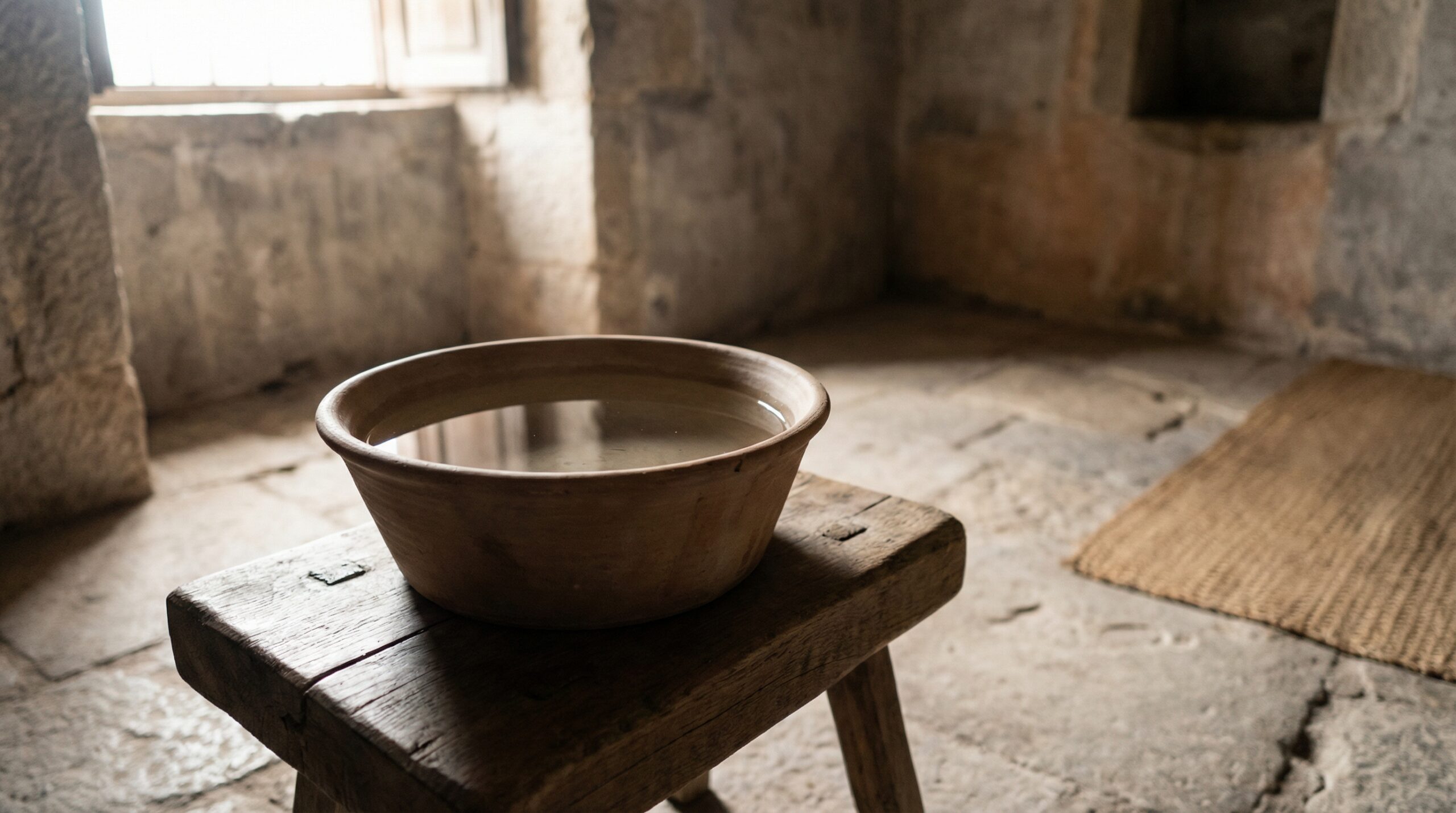
A clay basin filled with water resting on a rough wooden stool in a sparse stone room with soft window light

The foot-washing scene in John 13 is famous for the image it gives us of Jesus on His knees before His disciples. We tend to read it as a model of servant leadership — and it is that. But the most theologically loaded moment in the passage isn’t Jesus picking up the basin. It’s Jesus stopping in front of Peter, and Peter refusing to let Him.

Why Paul Says “Good Courage” Twice: What 2 Corinthians 5 Teaches About Living with an Eternal Horizon

A wide open valley with rolling golden fields and soft morning mist beneath a pale blue sky at sunrise

Most of us think of courage as something you summon when things get hard. Paul thinks of it as something you already possess — because of what you already know. In 2 Corinthians 5:6–10 he uses the phrase “good courage” twice in three verses, and both times it flows from a settled conviction about where this life is headed and where we ultimately belong.

What Christ-Like Humility Actually Looks Like — and Why It’s Only Possible in Him

A weathered wooden boardwalk winding through an open green meadow under a soft pastel sunrise sky

Christ-like humility isn’t a personality trait you develop or a discipline you practice until it sticks. It flows from a settled identity — from knowing who you are in Christ so completely that you no longer need to grasp for position, recognition, or status. Philippians 2:3–8 doesn’t give us a technique for becoming humble. It shows us what humility looks like when someone already knows they are secure.

Secret Link